


Leia esta reportagem em português.
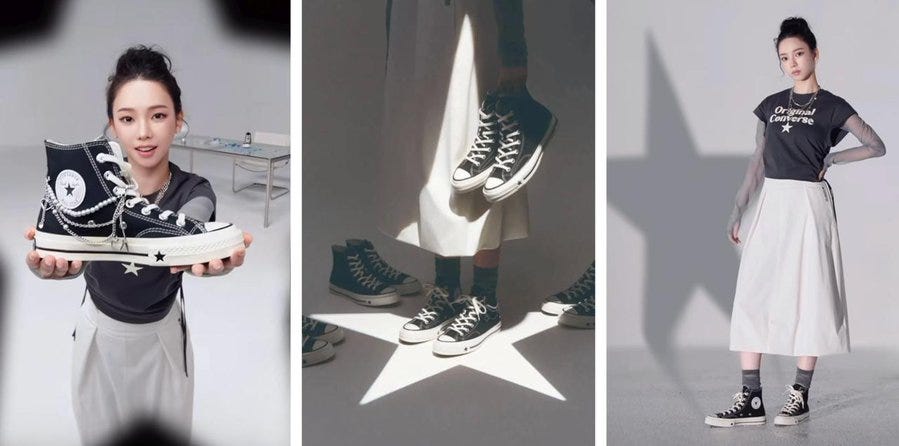
Converse, the American company behind the iconic Chuck Taylor All Star, removed from its channels a photograph of South Korean pop star Karina, apologized and began treating as a mistake an image created to sell the Chuck 70 X. The shoe remains on sale. What disappeared was the picture: a composition in which activists and celebrities saw a member of the Ku Klux Klan and the feet of a Black lynching victim.
Our reporting found a less conspiratorial sequence. The photograph belonged to Stars Align With KARINA, a campaign built around Converse’s own five-pointed star. It circulated for weeks before Threads users supplied it with a racial caption. Larger accounts repeated the interpretation, an image from a different campaign was attached as supposed evidence of repetition, resemblance became news and the company retreated.
Converse told People that it understood why the image was “deeply upsetting,” acknowledged that it had “got this wrong” and announced its removal. The statement did not admit that the company had designed a hood or staged a lynching. It was a predictable corporate response: deleting a file was cheaper than fighting a racial accusation. The apology limited reputational damage, but the same audience then treated it as the missing confession.

The controversy landed on prepared ground. Nine days before the backlash exploded on Threads, 59 Democratic members of Congress had described a series of deaths involving Black people found hanging as a “national crisis.” Their letter to the Justice Department and the FBI claimed at least ten cases in 2026, but the references cited by the lawmakers do not identify ten deaths from that year. The set includes officially established suicides, investigations with no evidence of a crime, unresolved cases and one homicide: the killing of Tasia Fortune. The accused man, Jarques Ratliff, is also Black. He has pleaded not guilty. Police have not announced a racial motive, and Fortune’s mother has said she believes the crime was personal.
The data help measure what the viral narrative erased. Suffocation—the CDC category that includes hanging, strangulation and asphyxiation—accounted for roughly 23 percent of U.S. suicides in 2024. Black Americans still had a lower suicide rate than White and Native American populations, but they recorded the largest proportional increase of the decade: about 53 percent between 2014 and 2024. KFF points to possible factors including differences in diagnosis and access to mental-health care, stigma, discrimination, changes in access to firearms and unequal awareness or use of the 988 crisis line. Population statistics cannot determine the cause of an individual death. They do show why the method alone is not proof of a racial execution.
A Investigação, the Brazilian investigative outlet that published this report, documented the same mechanism in coverage of an operation that located 163 missing children in Florida. Social-media accounts turned that number into evidence of an international trafficking network, although the operation produced only three arrests, no public evidence of a single organization connecting the cases, and a pool that included runaways, custody disputes, neglect, abuse and possible exploitation. In both episodes, unlike categories were stacked together, the gravest hypothesis filled the gaps, and the volume of attention began to substitute for evidence.
The photograph permits an unpleasant association, and the art direction may have failed to anticipate it. But the literal explanation remains simpler: the brand’s star was projected over a model holding the advertised product. There is no evidence of Klan propaganda, a lynching code or racist intent. There is an ambiguous image, a real historical trauma, an environment primed by panic and a corporation that chose to erase the work rather than defend its meaning.
The star that became a hood
Karina, a member of the K-pop group Aespa, was announced as a global Converse ambassador in 2026. The campaign promoted the Chuck 70 X and the Run Star Crush. On Aug 27, 2026, the company announced the worldwide launch of the Chuck 70 X under the concept Stars Align With KARINA.
In the photograph that became the focus of the backlash, a five-pointed star is projected like a spotlight. Karina stands at its center, wearing a white below-the-knee skirt and holding a pair of black high-top sneakers by their collars. One point of the beam crosses the skirt. The contrast erases part of her arm in shadow and leaves the shoes prominent. Once someone supplies the caption “KKK and lynching,” the pale triangle can resemble a hood and the suspended sneakers can be perceived as feet.
The composition offers visual footholds for that association, but it also explains every element without recourse to a clandestine message. The star is Converse’s symbol and the campaign’s declared concept. The black objects are the advertised product. Holding a pair of high-tops by their collars is an ordinary solution in footwear photography. To construct a lynching scene, the viewer must remove each element from its commercial function and recombine it into an image that is not literally present.
Although Karina is South Korean, Converse is an American company owned by Nike. The photographer was Marloes Haarmans, a Dutch artist based in London, and a team post identifies the work as styling for Converse Europe. Her work belongs to conceptual editorial and advertising photography, close to contemporary still life. She isolates objects in the studio and creates deliberately strange combinations: food becomes sculpture, utensils resemble organisms, and clothing loses its ordinary function to become an abstract form. The aesthetic evokes the Dutch still-life tradition in a pop and surrealist register, designed to interrupt the viewer’s first reading of a scene.
Some defenders argued that the advertisement had been made by Asians for the Korean market and therefore lacked American historical context. The public credits do not establish that claim. Karina is Korean, but the campaign was global; the credited photographer is European, the production post points to Converse Europe, and the brand itself is American. Nor does Asian identity imply ignorance of this history: Chinese immigrants were among the victims of mass lynching and Klan violence in the nineteenth-century American West. None of that proves the image was harmless. It shows only that the team’s nationality cannot substitute for evidence of intent.
The art direction is not beyond criticism. The team may have underestimated a foreseeable reading in a country where racial lynching remains a historical trauma. That is a judgment about ambiguity and visual carelessness. It is different from claiming, as a photographer quoted by The Washington Post did, that whoever produced the image “knew exactly” what they were doing. Professional status does not turn an interpretation into forensic evidence of intent.
Who lit the fuse
The campaign did not begin in September. The image and other Karina materials had circulated since August, and the Chuck 70 X launched worldwide on Aug 27, 2026. The accusation gained scale only on Sep 17, 2026, primarily on Threads. The delay weakens the claim that the racial meaning was self-evident on first viewing.
Among the posts reproduced by the press, Zach Berger supplied the formula that others copied: the advertisement was racist, resembled Klan clothing and depicted a lynching. Actress Yvette Nicole Brown asked, “That’s a lynching, yes?” and then added that she also saw a Klan robe. Another user, @michaelneverusky, connected the photograph to reports of Black people found hanging in the South. The caption stopped describing an impression and began accusing the company of a deliberate choice.
It is impossible to identify the first person who made the association. It is possible to trace the circuit that gave it scale: Threads, large accounts, fashion and Black media, the general press and politics. Women’s Wear Daily obtained the company’s statement. People and The Washington Post followed, as did Democratic Representative Troy Carter of Louisiana, who said the campaign appeared to show a hooded Klansman beside a hanging victim.
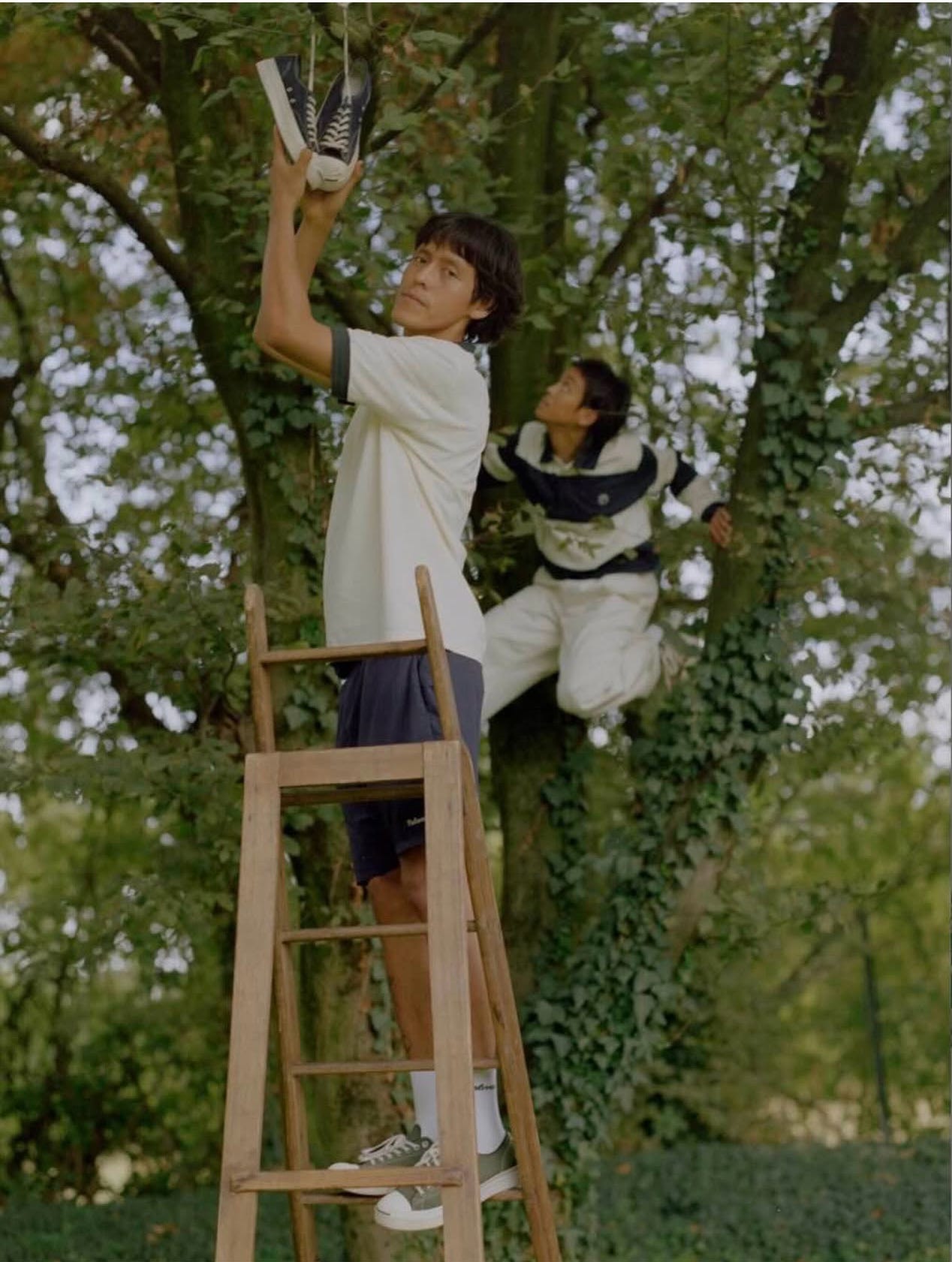
The theory of a “second offense” appeared when Threads user @danidoodlebug13 reposted a photograph from the Palmes × Converse collaboration: a man on a ladder raising sneakers toward a tree branch. She said the image “doubles down” on the message. Influencer Kida Maree later placed the two photographs side by side and invoked Strange Fruit, Billie Holiday’s song about lynching. The second photograph promoted the Jack Purcell PDM, a different product with a different concept, and it shows sneakers near a tree—not a body. It matters as evidence of how the accusation spread, not as proof of a coordinated racial message.
A Investigação found no organization claiming credit for the “discovery,” no paid campaign against Nike, no leaked brief, no admission from the photographer and no evidence that Karina participated in the lighting or editing choices. The public trail shows an older campaign, a later interpretation and a decentralized amplification mechanism. There was no identifiable headquarters. There was an effective caption.
The “lynching surge” that primed the eye
On Sep 8, 2026, nine days before the explosion on Threads, Representative Ayanna Pressley and 58 other lawmakers—all Democrats—sent a letter to Attorney General Todd Blanche and FBI Director Kash Patel. It claimed that at least ten Black people had been found hanging in 2026, described the phenomenon as a “national crisis,” and requested independent autopsies, audits of local investigations and reports to Congress.


The demand for rigorous investigations is legitimate. The numerical foundation is not. The letter does not name ten victims. It cites a Washington Informer story listing eight people and a separate story from TheGrio. The first included three deaths from earlier years—Javion Magee and Dennoriss Richardson in 2024, and Demartravion “Trey” Reed in 2025. The second dealt only with Demetrius Fleming, whose case remained open. The sources cited by Congress do not establish the count presented in the letter.
There is also a shift from “people found hanging” to “modern-day lynchings.” The first phrase describes the position of the bodies. The second assigns homicide, perpetrators and—in the historical frame being invoked—racial terror. The Washington Informer itself acknowledged that no evidence linked the deaths and that suspicion does not turn suicide into murder. Those cautions disappeared on social media when the faces were assembled into a single poster.
Kyle Bassinga, 21, was found dead in Fair Oaks Park in Georgia. Cobb County police said video, witnesses and other evidence showed that he was alone and that there was no indication of another person’s involvement. In Raleigh, North Carolina, cameras recorded a 32-year-old man walking alone to a tree carrying an electrical cord and also captured what followed. His mother described a history of mental distress.
Other cases retain legitimate uncertainty. Juliana Nzita, 16, was ruled a suicide, but her family has questioned the speed of the investigation and the absence of a full autopsy. To’Nea Nicole Miller’s death was also treated as suicide, with no sign of assault, although relatives disagree. The deaths of Justice Kai James and Demetrius Fleming still required fuller public explanation. The journalistic task is neither to trust police blindly nor to fill every gap with the same cause. It is to report the evidentiary status of each case.
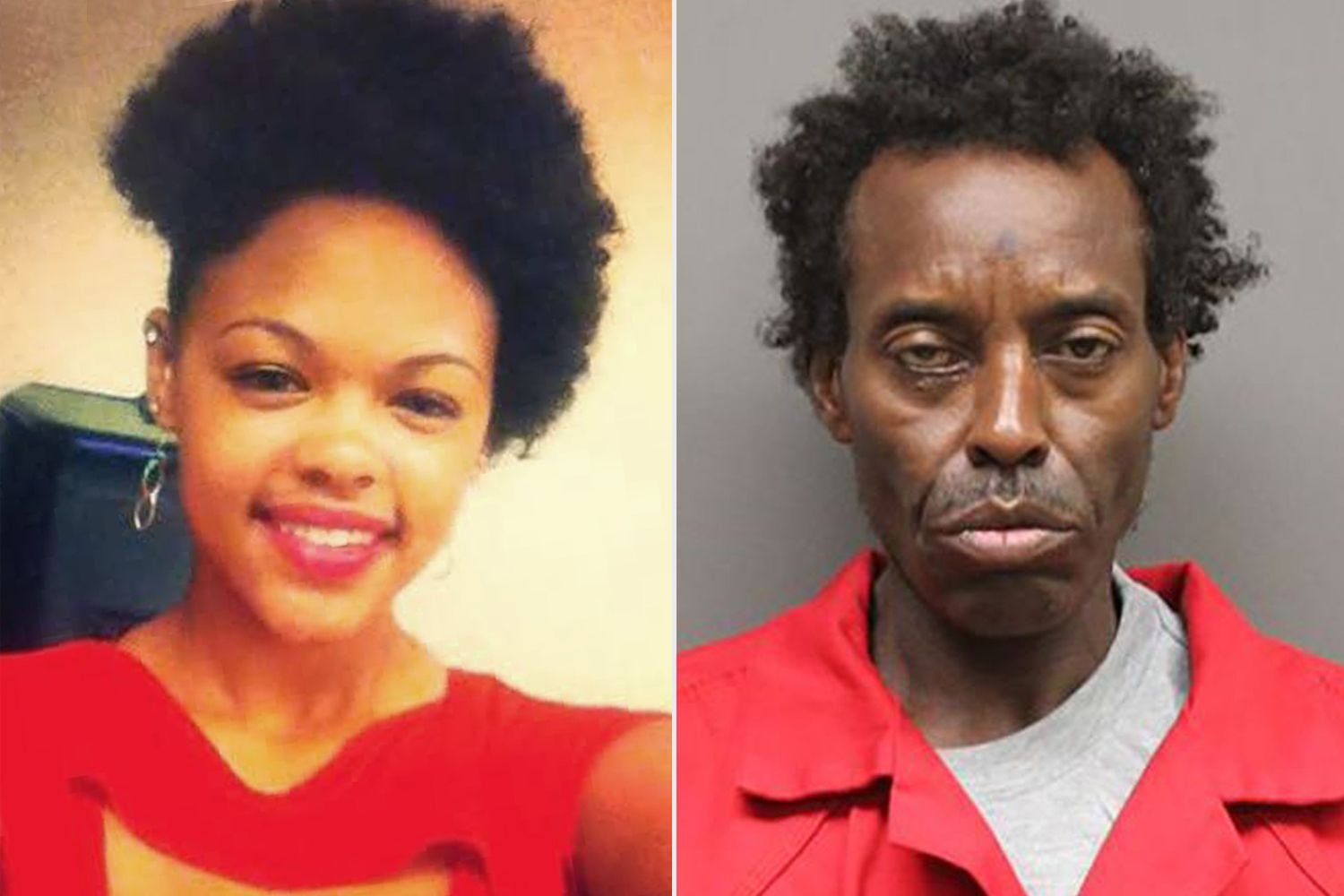
Tasia Fortune is the one confirmed homicide in the group. Jarques Ratliff was charged with murder and pleaded not guilty. The Associated Press reported that he is also Black, had some form of relationship with Fortune and that police expected additional arrests. The suspect’s race does not by itself exclude a hate crime, but authorities have announced no racial motive. Fortune’s mother told People that she did not believe her daughter died by suicide and regarded the killing as personal, not racial.
The broader statistical context does not support shortcuts either. The United States recorded about 48,800 suicides in 2024. Suffocation—a category that includes hanging, strangulation and asphyxiation—accounted for roughly 11,500 deaths, or 23 percent of the total, second only to firearms. The method alone does not distinguish suicide from homicide.
Suicide rates also complicate the impression created by the feed. In 2024, the rate was 22.5 deaths per 100,000 among American Indian and Alaska Native people, 17.2 among White people and 8.7 among Black people. The Black rate was not the highest, but it grew the most over ten years: about 53 percent, compared with 5 percent among White people. The CDC found a 25 percent increase among Black Americans from 2018 to 2023, with rises of roughly 30 percent among people aged 10 to 24 and 25 to 44.
There is no single cause. KFF says the increase among people of color may reflect differences in diagnosis and access to mental-health care, stigma, discrimination, changes in firearm access and differences in awareness or use of the 988 crisis line. These are possible explanations for a population trend, not automatic explanations for individual deaths.
For its broader claim of more than 70 “modern-day lynchings” across the South since 2000, the congressional letter cites A Crimson Record, a February 2026 report by JULIAN, a civil-rights nonprofit founded by attorney Jill Collen Jefferson. The report places more than 70 deaths from seven Southern states inside one analytical frame, including hangings, deaths in custody, killings of transgender women and cases without a proven discriminatory motive.
The document is an advocacy report, not a reproducible forensic database. Its methodology draws on news coverage, digital archives, partner organizations, social-media platforms, calls, messages and public referrals. It says JULIAN applied its own criteria even when formal hate-crime charges were absent. It does not provide a complete auditable dataset showing the source hierarchy, evidence assigned to each case or the threshold that turned “strong likelihood” into “virtual certainty.” The report itself acknowledges that most cases it examined were officially classified as suicides, homicides without a proven discriminatory motive or conventional hate crimes. That may justify reopening particular cases. It does not establish more than 70 lynchings as a statistical fact.
The Brazilian precedent
Brazil offers a useful comparison because the same statistical operation helped produce a claim repeated around the world: that Brazil is the country that kills the most LGBT people. The principal source was Grupo Gay da Bahia (Gay Group of Bahia), or GGB, which describes itself as Latin America’s oldest LGBT organization and has compiled annual death lists since 1980. Brazil has no comprehensive official national database that consistently records anti-LGBT motive, so the GGB’s press-clipping survey was widely treated as an official statistic by Brazilian and foreign media, international organizations and political campaigns.
In 2019, Eli Vieira, Camila Mano, Daniel Reynaldo, David Ágape and Vanessa Bigaran published an independent audit through the Brazilian Secular Humanist League. The team reconstructed all 347 cases in the GGB’s 2016 list from news reports and public records. Thirty entries were excluded because they were duplicates, occurred outside Brazil or could not be sourced. Among the remaining cases, only 258 were confirmed homicides; 31 could be supported as deaths motivated by anti-LGBT prejudice. That was 9 percent of the original total. A preliminary review of the GGB’s 2017 homicide cases found a proven anti-LGBT motive in only 6 percent, while 42 percent showed no such motive.
The audit did not claim that Brazil was safe for LGBT people or that anti-LGBT violence did not exist. It showed that the available dataset could not sustain the global ranking built from it. The original list included suicides, accidents, deaths abroad, duplicates and killings driven by robbery, organized crime or personal disputes. Identity had been converted into motive before the cases were added together. GGB founder Luiz Mott acknowledged that the organization’s survey was incomplete but rejected the scale of the criticism, arguing that disputed cases were rare and that structural homophobia remained an aggravating factor.
Daniel Reynaldo applied the same case-by-case method to the Dossier on Lesbocide in Brazil, a study produced by researchers linked to the Federal University of Rio de Janeiro. The dossier listed 126 deaths of lesbians between 2014 and 2017, drawing primarily from social media and news reports. Reynaldo found only two cases that were clearly crimes motivated by prejudice. The list also included an accidental vehicle death, a suspect killed in a shootout with police, a woman caught in a bank robbery and a woman killed by her female partner. The issue was not whether those deaths mattered. It was whether the victim’s sexual orientation, by itself, established the motive.
Families have the right to challenge official findings, demand autopsies and distrust authorities. American history gives them reasons for that distrust. But history is not a substitute for forensics. When suicides, homicides and open investigations are stacked into a single wave of lynchings, a real mental-health crisis disappears inside a different narrative—and that narrative begins to direct the eye even when it looks at a sneaker advertisement.
When woke activists see a pig’s snout in an electrical outlet
In 2020, University of Southern California professor Greg Patton used the Mandarin expression nèi ge—“that one,” also used as a verbal filler during a communications class. Some students heard the English racial slur. The university removed him from the course, although an internal investigation later found that he had violated no policy.
In Brazil, a similar misunderstanding repeatedly surrounds the Procissão do Fogaréu (Procession of the Torches), a Holy Week ritual staged in the colonial city of Goiás since 1745. Its farricocos wear long robes and pointed hoods while representing the soldiers searching for Jesus. The costumes belong to an Iberian medieval penitential tradition that predates the Ku Klux Klan by more than a century. Yet photographs of the procession are periodically read through the American racial repertoire as Klan imagery. In both cases, a sound or silhouette is removed from its original context and translated through U.S. racial history; the observer’s association is then treated as the speaker’s, worshipper’s or photographer’s intent.
In the Converse controversy, there is not even an actual hood—only an image that can be made to resemble one. The brain does not receive images like a neutral camera. It searches for familiar forms, completes contours and tests hypotheses against prior expectations. The same mechanism that helps recognize a face in a crowd can turn an electrical outlet into a pig’s snout. This is pareidolia: perceiving a meaningful figure in an ambiguous arrangement of light, texture and shape.


In 2014, researchers called the phenomenon “seeing Jesus in toast.” A study published in Cortex found that prior suggestions changed what participants reported seeing in images made of visual noise. The University of Toronto explained the result as a normal interaction between expectations formed in the frontal cortex and visual processing. A religious observer primed to find a sacred sign may recognize Christ in a water stain, the Virgin Mary on a window or a face on a piece of toast. The form provides the points; the observer’s repertoire completes the figure.
In the Converse photograph, the illuminated point exists; the white skirt exists; the suspended sneakers exist. The hood and the corpse are the observer’s synthesis. Once the interpretation is stated, it becomes difficult to return to the original elements. The caption works like the suggestion in the experiment: it directs the eye before the eye examines the scene.
In this episode, woke activism applied to racial imagery the same readiness with which religious believers find sacred images. Its vocabulary searches for hidden codes, dog whistles, racial absences and structures of oppression. Faced with ambiguous material, the gravest hypothesis received priority. Interpretation moved from possibility to certainty without passing through evidence.
The next step is collective. A Science Advances study based on nearly 13 million posts found that likes and shares increased the probability of future expressions of moral outrage. The study did not examine this Converse campaign and cannot explain every critic. It does describe an architecture that rewards the maximum accusation: outrage produces engagement; engagement validates outrage; repetition creates the appearance of consensus.
That reward system fits the moral-panic model described by Stanley Cohen in Folk Devils and Moral Panics. As A Investigação has explained in previous reporting, a panic requires a folk devil—a figure onto which a diffuse threat can be condensed and against which outrage can organize. Here, the Converse creative team was recast as a cell of white supremacists hiding racial codes inside a sneaker campaign.
Once the villain had been chosen, every gap confirmed the thesis: ambiguity became a dog whistle, the ladder photograph became a repeat offense, and the apology became a confession. Celebrities, the press and a member of Congress gave the accusation public authority before any evidence of intent appeared.
We need you.
Reports like this have a cost. Beyond the investigative work, there’s a whole technical infrastructure that allows us to publish without depending on advertisers or political patrons.
We do this independently—and independence has a price.